

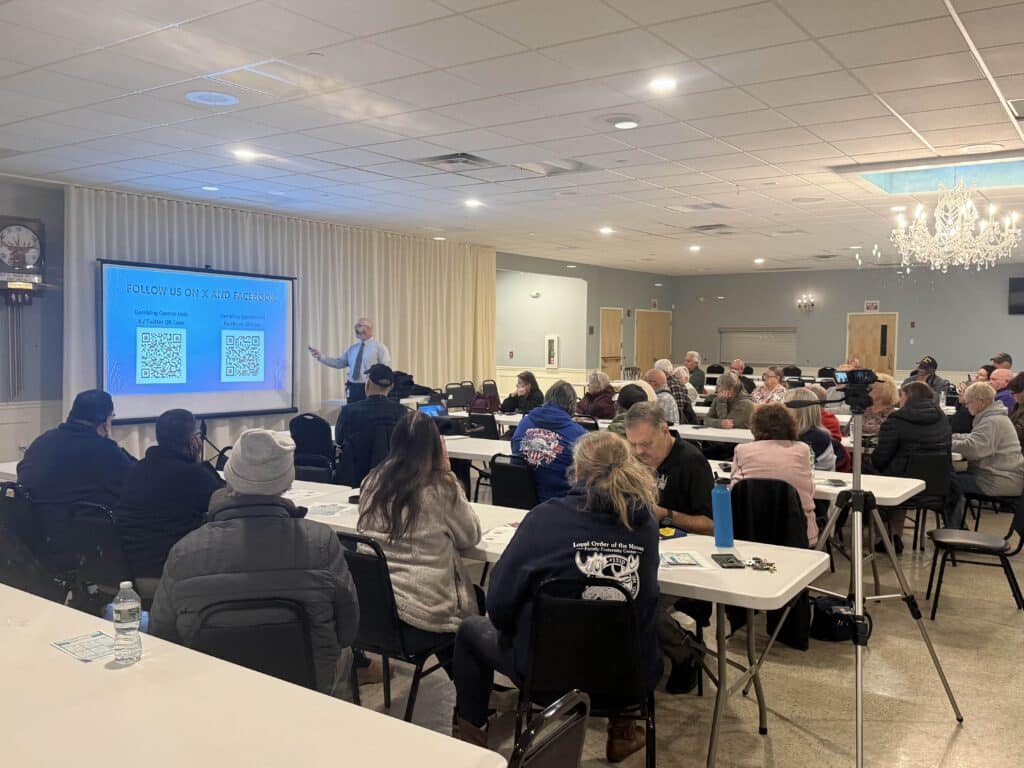
This fall, the Maine Gambling Control Unit (GCU) hit the road for seven town hall meetings to talk directly with nonprofits about charitable gambling. Raffles were only one slice of the conversation, but the themes that kept surfacing are the same ones that make or break raffles, bingo, pull tabs, Queen of Hearts, and all games of chance.
We personally were present at all meetings and compiled our own notes. This post is a practical summary of what came up most, what the GCU seemed to be emphasizing, and what you should do next.
DISCLAIMER
This post reflects our interpretation of what we heard and read from the Maine Gambling Control Unit’s 2025 town hall meetings. We did our best to be accurate, but we could be wrong, miss context, or misunderstand something.
We are not the GCU and we are not attorneys. This is not legal advice and should not be treated as official guidance. Laws and rules can change, and your situation matters.
Before running or changing any charitable gaming, review the current rules and contact the Maine Gambling Control Unit with specific questions.
The 60-second summary
If you only read one section, read this:
- The Unit wants you to use their website as the source of truth. Do not rely on saved or printed forms. Always pull the latest versions online, check the “last updated” date, and use the GCU’s Bill Tracker to follow active legislation that could change the rules.
- “House Rules” are not fluff. In the gray areas, the answer kept coming back to: decide a policy, put it in writing, and run the game the same way every time.
- Internal controls are the headline. They are seeing too many situations where money is collected and later “doesn’t make it” to the bank. Their advice: Segregation of Duties, repeatable processes, and audit-proof recordkeeping.
- Optics matter almost as much as math. If players think a game is rigged, you lose trust, donors, and sometimes your license. That is why they recommended, for example, buying Queen of Hearts boards from licensed dealers instead of building your own.
- The most repeated question was about who can and can’t play. If you are conducting a game of chance, you cannot participate as a player/contestant in that game, and neither can your immediate family. “Immediate family” is defined as spouse, parents, and children. This came up in room after room because one bad situation forced a blanket rule that frustrates a lot of organizations, especially smaller ones.
Why the GCU did these town halls (and what that signals)
The tone across the meetings was consistent: the Unit wants fewer “gotcha” problems and more prevention.
They repeatedly pointed people back to:
- The Charitable section of the GCU website, including the bill tracker for upcoming changes.
- A plan to make things simpler with a portal where organizations can submit applications, requests, and payments in one place.
- A willingness to work with organizations that are genuinely trying to comply (example given: if weather forces a schedule change, email them).
That last point matters. A regulator that says “call us, we’ll help” is also quietly saying: “If you wing it and hope nobody notices, that’s on you.”
Theme 1: “House Rules” are your best compliance tool
A lot of nonprofit frustration starts here: something is not spelled out cleanly in statute or rule, but your organization still has to run a game tonight.
This is where House Rules come in.
House Rules are your organization’s written “how we run this game” policies. They sit underneath Maine law and GCU rules. They cannot override them, but they can fill in the gaps when the law is silent, unclear, or gives you flexibility. Think of them as the playbook you hand to volunteers and point to when a player says, “That’s not fair,” or “You never told us that.”
Across the town halls, the GCU repeatedly nudged nonprofits toward House Rules because they solve three problems at once:
- Consistency: you run the game the same way every time, no matter who is volunteering.
- Transparency: players know what to expect before money changes hands.
- Protection: if there’s a complaint, you can show you had a clear rule and followed it.
Example: Partner Bingo
Partner Bingo is now allowed, but the Unit encouraged nonprofits to decide how they want it handled and write it down as House Rules (who can help, when, and what “help” looks like).
Example: Marking pull tab boards
The Unit said there is no law or rule requiring marking or not marking boards, but the decision should be made and put into House Rules so the game runs consistently. They also mentioned a study where organizations that did not mark boards raised more money.
The practical takeaway
In plain terms: when the rulebook is fuzzy, the Unit would rather you choose a reasonable policy, write it down, and follow it consistently than improvise in front of a crowd.
Theme 2: Protect the money (because too many people are not)
If there was one theme that cut through every room, it was this: money handling is where good organizations accidentally get sloppy, and where bad actors do real damage.
GCU shared a recent example out of Skowhegan that set the tone.
In their telling, a single volunteer had become the entire system: signed the license, ran the games, sold the tickets, handled the cash, and closed everything out. That is convenient, until it is a disaster. As GCU put it, this is a cash business, and when one person does it all, it can be as simple as “the deposit bag stays in the car” and only part of it ever makes it into the bank.
GCU said the situation came to a head when reports were not being submitted for an extended period, licensing could not be renewed, leadership got involved, and the organization pulled in law enforcement. They referenced an indictment tied to the situation, with the number discussed landing around $103,000. Public reporting later echoed those same headline numbers and allegations.
That single case didn’t stay “single” for long.
GCU said it directly triggered a wave of audits. Their blunt takeaway: once they started looking, they kept finding the same pattern in different forms. In one stretch, they described doing “4 or 5, maybe 6” audits and seeing organizations “hemorrhaging money” in amounts ranging from tens of thousands to even hundreds of thousands. They also cited examples like an audit finding over $60,000 missing even when records looked “perfect,” because money collected simply did not make it to the bank. Another example they mentioned involved roughly $150,000 that “got in the car, never got out of the car.”
Here’s the part that matters for well-run nonprofits: GCU wasn’t saying “everyone is stealing.” They were saying your controls are weaker than you think, and when controls are weak, you get theft, mistakes, or both.
The Fix GCU Kept Coming Back To: Segregation of Duties
Their advice was consistent and honestly pretty practical:
- Stop building a one-person financial pipeline. One person should not be the signer, the counter, the depositor, and the reporter.
- Use dual-signature or a second set of eyes where you can. GCU specifically called out how often “dual signature” and basic verification would have prevented most of what they were seeing.
- Split the flow: one person collects, one counts, one verifies, one deposits. Even small versions of this reduce risk fast.
Bottom line: the state is auditing more, not because most nonprofits are bad, but because a few ugly cases exposed how easy it is for money to disappear when one person runs the whole show.
Note: GCU said that if your nonprofit wants an audit, you can simply call and request one, and they can send their auditor.
Theme 3: The GCU Website is your playbook (and the Bill Tracker is the cheat code)
Across the town halls, GCU staff kept telling nonprofits the same thing: stop hunting for answers in old binders, saved PDFs, or Facebook comments. Go to the website. They literally said the Charitable section is “where you all will live” and emphasized: “Please go to the website. Use the website.”
What to use on the site
- Statutes vs Rules: They explained the difference because it matters. Statute is what the Legislature passes. Rules are how the Unit administers it in practice.
- Current forms: Pull them fresh from the site. Do not trust old downloads or Google results. They also added the dates the form was last updated to make it clear it’s changed.
- Bill Tracker: They built it because the legislative site is hard to follow, and they update it about twice a day during session.
- Email updates: Get on their list so changes do not surprise you. Email Gambling.Control@maine.gov and ask to be added to list.
A simple habit that prevents headaches
Check the Bill Tracker weekly, pull forms fresh when you apply or report, and use the website as your “current version” source before every event cycle.
Theme 4: Who can play, who cannot, and why this keeps exploding
This was the most emotionally charged topic in multiple rooms: “who is allowed to participate in a game of chance” The GCU’s core point was simple: even if nobody is cheating, the appearance of insiders winning destroys trust fast.
The key situation that triggered the crackdown
GCU staff repeatedly referenced a real Queen of Hearts incident as the reason this got tightened up. In their telling, the person “conducting” the game also signed the license, built the board, played anyway, and then won the jackpot prize of over $40,000. They compared the optics to “the priest winning the Mercedes” in a church raffle, and said they got angry calls the next day.
That single scenario created pressure to “fix” the issue statewide, not just in one town.
The “fix”: a new blanket rule now in effect statewide
After that Queen of Hearts situation, the Unit’s response was a statewide “fix,” not a case-by-case warning. They needed something enforceable that applied to all games of chance and all nonprofits, even if it felt too broad.
The result was a blanket rule that is now in effect:
- If you are conducting (touching) the game, you cannot play in that game.
- If you are conducting the game, your immediate family cannot play in that game either.
They explained “conducting” as doing anything that can influence the game or the money flow: taking payments, paying out, running transactions, loading/filling machines, crossing off tickets or placards, and similar hands-on actions.
They also drew a line between “touching the game” and harmless manual labor. Example: moving boxes into a storage room is not conducting.
Immediate family was described as spouses, children, and parents (and they emphasized this is defined, not improvised).
Why so many nonprofits are mad about it (and the GCU said they get it)
Nonprofits pushed back hard because the rule can wipe out a big chunk of the people who reliably buy tickets, especially in small towns where “everybody is related.”
The GCU acknowledged the frustration directly, especially for small organizations where the same few people volunteer for everything.
They also heard the practical fear: “This alienates a huge chunk of people that would normally play,” and it can make groups want to stop running games.
What the GCU says they plan to do about it
Their direction (still in-progress) was basically: replace the one-size-fits-all rule with something more flexible that forces each organization to explicitly address the “who can play” problem inside its own House Rules.
They said they do not want to micromanage how you run your operation, and they only have two inspectors, so the goal is to push more of this detail into your House Rules in a way that fits your org.
They also said they’re working on examples, and that they want House Rules that actually address the hard questions (not generic filler).
And they were blunt about why they are doing it: the current approach is “a mess,” it is a “blanket,” and it “doesn’t work,” but it exists because something happened and the state got complaints.
Theme 5: Online raffles are not “basically illegal.” DIY online ticket sales are.
Surprisingly, a lot of nonprofits still assume online raffles are illegal in Maine. Across the town halls, the GCU repeatedly stressed that’s not the case, but they also made it clear that internet raffles come with compliance problems you don’t have at an in-person table.
Their phrase summed it up: “Internet raffles can be tricky.”
The “tricky” part is not the raffle. It’s the stuff behind the scenes: knowing who is buying, where they are, and having records that hold up if there’s a complaint.
That’s why they kept recommending licensed platforms
In multiple meetings, the GCU strongly recommended working with a licensed internet raffle operator or payment management system because it offloads the compliance-heavy parts that nonprofits routinely get wrong.
They described it like this:
- Compliance and paperwork: “They will keep you legal… They will not let you submit a janky form… they will literally do it for you.”
- Reporting: “Guess what, they’ll do the reporting too.”
- Ticketing flow: they talked through the online flow as “selling them online, creating a ticket,” then handling the draw process from there.
- Age and location controls (KYC): “Know your consumer… mechanisms… to know who it is and… wherever it is,” and “They take care of the KYC part for you.”
- Computers are never wrong: “They do all the reporting for you. They’re perfect. The computer never lies. Not once.”
The warning they repeated
They also warned against selling tickets online through payment apps without the proper structure. One meeting stated it plainly: Venmo/PayPal-type online payments for raffle tickets are illegal without a payment management system.
What the GCU actually wants you to solve
- Reasonable age checks
- Strong location control (avoid out-of-state sales)
- Clean records and reporting
- A process you can defend if someone claims the game was unfair
That’s the core message: online raffles are allowed, but the GCU wants them run in a way that’s verifiable, defensible, and compliant.
The “most asked” questions (and the best answers we heard)
These were the repeat questions that kept coming up across rooms, often in multiple forms.
1) “How do we stay informed?”
Join the email list and watch the bill tracker.
2) “Can someone help someone else play Bingo?”
Partner Bingo is allowed now, but the Unit wants your nonprofit to define limits in House Rules.
3) “Can we keep selling Bingo paper after games start?”
In one town hall, staff indicated selling additional paper during a session can be okay if it is for that session and it is not handled in an aggressive or confusing way.
If you do it, write a clear policy and follow it consistently.
4) “Do we have to mark pull tab boards?”
No hard rule either way, but make a decision, put it in House Rules, and stick to it.
5) “Who can and can’t play games of chance?”
This is the hot button. It came up constantly and was tied to complaints that forced a blanket approach. Expect changes, but not instantly.
6) “Can we run a football pool or friendly cash game?”
A key distinction came up: social gaming is only “social” if the house does not profit and all money is paid out, and even then, running it through an organization can create optics problems fast.
If money is on the table outside a home setting, GCU strongly implies it moves into licensing territory (dice was specifically mentioned).
A few moments that made these town halls worth attending
These meetings were not dry. A few moments captured the reality of charitable gaming in Maine:
- A reminder that charitable gaming is a cash business, and that is why controls matter.
- A surprisingly honest explanation that the Unit only has limited inspection capacity, so they rely on rules, documentation, and complaints to guide enforcement.
- A point-blank suggestion that if you want flexibility on bingo dates, you should avoid locking yourself into one exact date via municipal consent if your town will allow a broader letter.
- And yes, the kind of “only in Maine” story where somebody tried to make a roulette-style game using a muffin tin. It was brought up as an example of how creative ideas can collide with strict definitions.
- The scale is bigger than most people realize: The GCU said charitable gaming generates about $70,000,000 per year in reported revenue for Maine nonprofits, and they suggested the true number could be closer to $100,000,000 once you include games that are not fully captured by reporting.
What we recommend every nonprofit do next
If you run any charitable gaming, do these five things this month:
- Assign one person to own compliance. Not to do everything, but to make sure someone is accountable.
- Write or update House Rules. Especially for Partner Bingo, pull tab board marking, and anything that causes arguments.
- Implement segregation of duties. Even if you are small. Especially if you are small.
- Stop using saved forms for permits. Pull them from the website every time, and check the “last updated” date.
- Ask questions early and often. The Unit repeatedly signaled they would rather answer questions upfront than deal with a mess later.
How Maine Online Raffles fits into this
If you read these town halls and thought, “Okay… but how do we actually fundraise without stepping on a landmine?”
Here’s the simplest answer: don’t DIY the compliance-heavy parts. Use an online raffle, and outsource the platform, guardrails, and recordkeeping to a legal, approved partner whose job is to keep you inside the lines.
The GCU’s consistent message was that online raffles are allowed, but “tricky,” and they repeatedly encouraged nonprofits to work with a licensed setup instead of piecing something together with payment links and hope.
Maine Online Raffles is built to handle the parts that cause problems:
- A compliant online flow that’s predictable. Clear steps for donors, clear rules, and fewer “wait, what just happened?” moments.
- Location and age safeguards. The same “know your consumer” concept the GCU kept stressing, including making sure buyers are where they’re allowed to be.
- Ticketing that’s clean and traceable. Every entry ties back to a real order, with records you can export and keep.
- Reporting-ready recordkeeping. Built so your after-the-raffle work is organized, not a scramble.
- Fewer optics problems. The systems and logs are designed to reduce the “it looked rigged” complaints that force the state into blanket rules in the first place.
If you’re considering an online raffle, here’s what happens next
- You tell us what you want to raise money for and what the prize is.
- We build the raffle around a compliant, donor-friendly system including ticketing, purchase flow, and the guardrails that keep things clean.
- We launch it with you and keep it organized the whole way through so you’re not scrambling at the end for records, reporting, or “what happened with that order?” answers.
If you want to move fast, send us the prize, your target launch date, and your fundraising goal. We’ll take it from there.